Dual nature , with observer and without observer 🙂
YABETTERNOT on
double slit interference pattern
bowser-us on
Loss
Kirda17 on
This is funny
SupersiblingzYT on
“Shoot some electrons to a double split! What do you get? What do you get?”
ThatGoofyMoth on
I remember seeing something like this like 5 years ago maybe 7
BladeBlaster85 on
The experiment that revealed the dual nature of photons, both particule and wave, depending on how we observe it.
Yashrajbest on
Every realistic light mod should now have this
[deleted] on
[deleted]
FunkinAstronaut on
Observer Effect
apatheticchildofJen on
Nobody has given you an in depth explanation, so I’ll give you one:
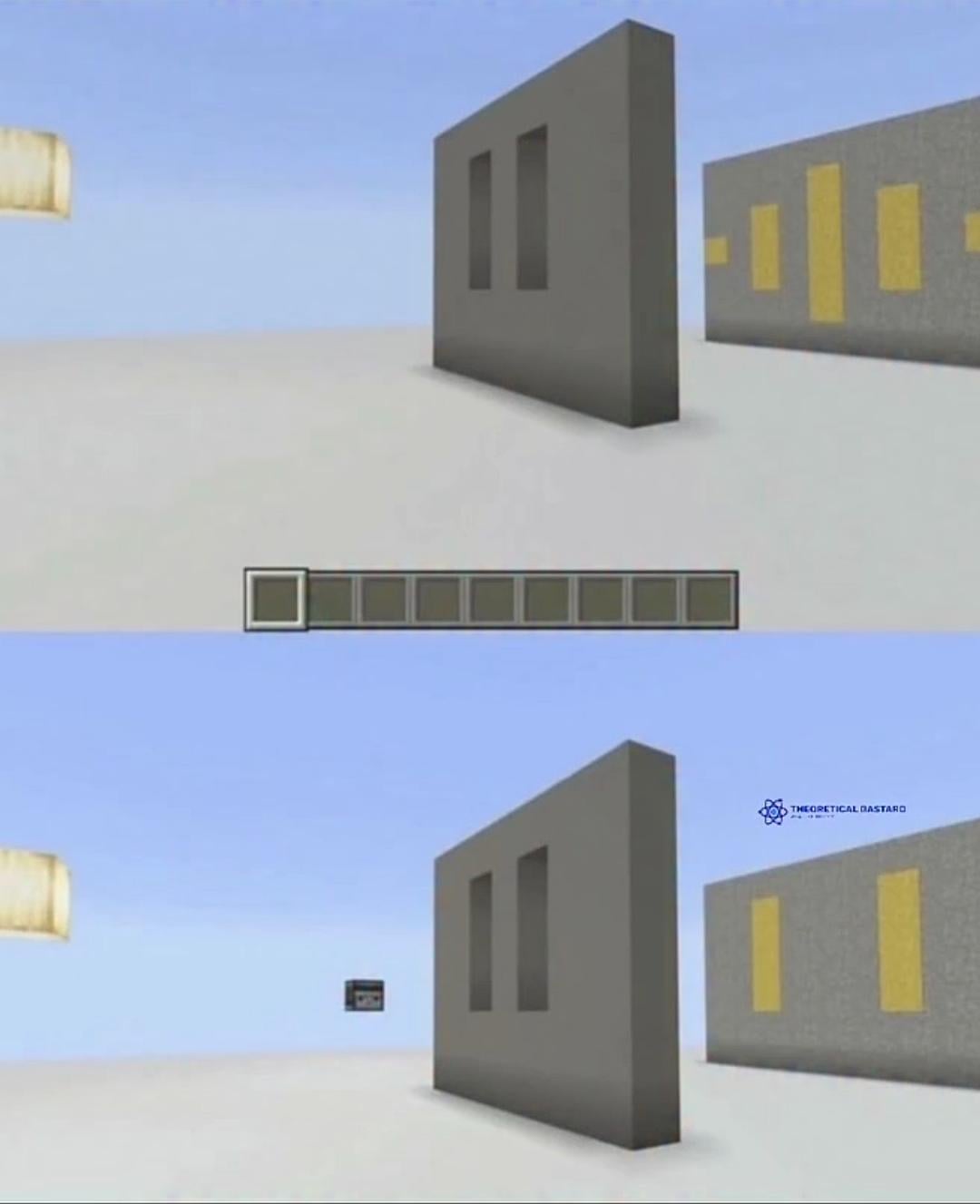
This is a representation of the double slit experiment.
When waves pass through the slits, they diffract (you can google videos of this to better visualise). As the waves diffract through the 2 holes and collide with the wall, the waves interfere with each other. Where the waves line up, they become stronger. Where they don’t line up, they become weaker (constructive and destructive interference)
The experiment is generally done with light due to it being easy to see the results. What we see are bright lines (the gold) where the light waves line up and interfere constructively, and dark everywhere else.
(This is specifically when there’s only one wavelength. It gets messy when there’s multiple wavelengths (colours) of light, but looks cool)
That’s the first image. The second image is quantum physics.
Put simply, quantum physics is weird. Getting a bit more detailed, light isn’t always a wave. Sometimes light behaves as a wave (double slit experiment) and sometimes it behaves as a particle (the second images and also the photoelectric effect)
Light is a wave until it interacts with something, at which point the ‘wave function’ collapses and light becomes a particle.
People say that when you observe the light before it enters the slits, they become particles, then when they go through the slits, they aren’t waves so aren’t diffracted. As a result, you only get the 2 bright lines (gold)
This is true, however, the word “observe” is misleading. It implies that merely looking at something, even when you don’t touch it, changes the outcome of the experiment. This is not true. In order to observe something as small as light, you must interact with it. Like how you see light that has bounced off walls, that light interacted with the walls to show you their colour. To observe the light, something must interact with it, collapsing the wave function, it producing light particles instead of waves
Feel free to ask questions, I understand I just through a lot of complicated physics at you and am not the best teacher, but I want you to understand if you want to understand.
TLDR: the top experiment shows light behaving as a wave and diffracting in the double slit experiment. The bottom experiment is showing how observing (interacting with) the light before it goes through the slits, turns it into a particle and it doesn’t diffract.

12 Comments
Quantum physics
Dual nature , with observer and without observer 🙂
double slit interference pattern
Loss
This is funny
“Shoot some electrons to a double split! What do you get? What do you get?”
I remember seeing something like this like 5 years ago maybe 7
The experiment that revealed the dual nature of photons, both particule and wave, depending on how we observe it.
Every realistic light mod should now have this
[deleted]
Observer Effect
Nobody has given you an in depth explanation, so I’ll give you one:
This is a representation of the double slit experiment.
When waves pass through the slits, they diffract (you can google videos of this to better visualise). As the waves diffract through the 2 holes and collide with the wall, the waves interfere with each other. Where the waves line up, they become stronger. Where they don’t line up, they become weaker (constructive and destructive interference)
The experiment is generally done with light due to it being easy to see the results. What we see are bright lines (the gold) where the light waves line up and interfere constructively, and dark everywhere else.
(This is specifically when there’s only one wavelength. It gets messy when there’s multiple wavelengths (colours) of light, but looks cool)
That’s the first image. The second image is quantum physics.
Put simply, quantum physics is weird. Getting a bit more detailed, light isn’t always a wave. Sometimes light behaves as a wave (double slit experiment) and sometimes it behaves as a particle (the second images and also the photoelectric effect)
Light is a wave until it interacts with something, at which point the ‘wave function’ collapses and light becomes a particle.
People say that when you observe the light before it enters the slits, they become particles, then when they go through the slits, they aren’t waves so aren’t diffracted. As a result, you only get the 2 bright lines (gold)
This is true, however, the word “observe” is misleading. It implies that merely looking at something, even when you don’t touch it, changes the outcome of the experiment. This is not true. In order to observe something as small as light, you must interact with it. Like how you see light that has bounced off walls, that light interacted with the walls to show you their colour. To observe the light, something must interact with it, collapsing the wave function, it producing light particles instead of waves
Feel free to ask questions, I understand I just through a lot of complicated physics at you and am not the best teacher, but I want you to understand if you want to understand.
TLDR: the top experiment shows light behaving as a wave and diffracting in the double slit experiment. The bottom experiment is showing how observing (interacting with) the light before it goes through the slits, turns it into a particle and it doesn’t diffract.