
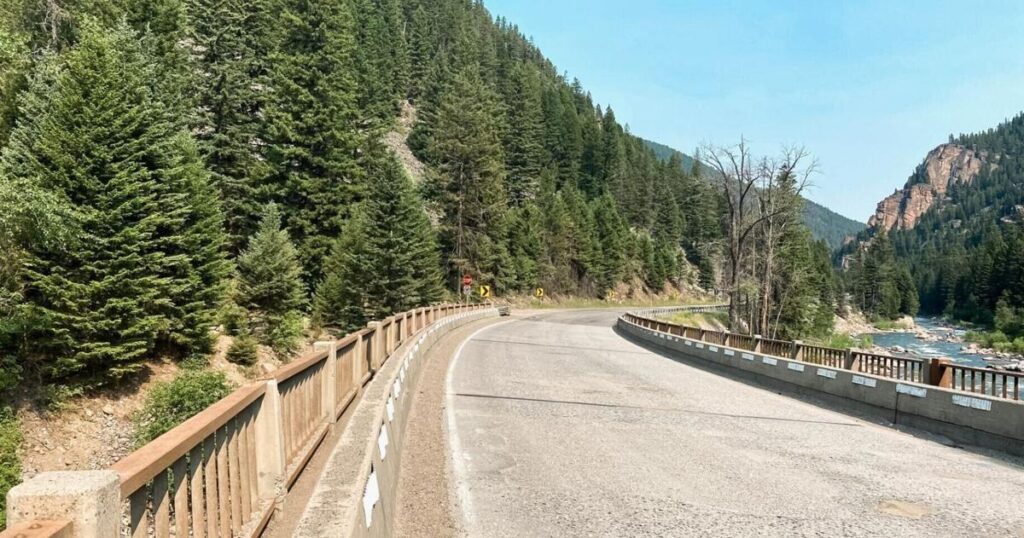

A stretch of U.S. Highway 191 through Gallatin Canyon. (Courtesy of Kylie Bute)
Courtesy of Kylie Bute
The Montana Department of Transportation is applying for an approximately $28 million federal grant to help cover construction costs for a wildlife crossing at the mouth of Gallatin Canyon along U.S. Highway 191, north of Big Sky.
Montana has the second-highest per-capita rate of wildlife-vehicle collisions in the country, according to State Farm’s 2026 “20 Years of Animal Collision Data” report. In Montana, drivers have a one-in-54 chance of colliding with an animal. The proposed wildlife aims to mitigate these wildlife-vehicle collisions, reduce property damage costs, protect wildlife and increase driver safety. The project has been in the works for six years.
“Securing the federal funding is really the only way this project is going to move forward,” said Elizabeth Fairbank, a road ecologist with the Center for Large Landscape Conservation.
Wildlife collisions account for 24% of all reported crashes on the U.S. 191 study corridor, according to a 2020 MDT Corridor Study — 2.4 times the state average and nearly five times the national rate.
In an effort to curb these numbers, the CLLC launched a feasibility study into developing wildlife crossing infrastructure in Gallatin Canyon in 2024.
Drawing on data collected by the MDT in 2020, the CLLC identified priority areas with high frequencies of wildlife-vehicle collisions. From there, Fairbank said the CLLC worked with landowners to identify places where installing wildlife crossings would be feasible, and developed a rendered conceptual wildlife crossing structure design.
With the compiled data, landowner permission secured and the conceptual rendering created, MDT and the CLLC submitted an application for $26 million through the federal Wildlife Crossings Pilot Program in 2024. While the proposal was highly rated by the U.S. Department of Transportation’s Federal Highway Administration, it was ultimately not selected for funding.
The Wildlife Crossings Pilot Program aims to reduce wildlife-vehicle collisions and bolster habitat connectivity, according to the U.S. Department of Transportation. This year marks the final application cycle of WCPP funding, and Fairbank said there is $80 million available for allocation countrywide.
“Last round, our application was designated as ‘highly recommended’ for funding, but the funding requests (for) all of the highly recommended projects was five times higher than the amount they had to send out the door,” Fairbank said.
Due to inflation, the projected engineering and construction cost of the Gallatin Canyon wildlife crossing has increased from the originally-requested $26 million to $28 million, per Fairbank. MDT plans to apply for the full funding amount this cycle.
If awarded, the grant would fund construction and engineering costs for a wildlife overpass, installation of cattle guards, fencing and jump-outs.
“The Wildlife Crossings Pilot Program was only a five-year pilot. We’re hoping it becomes permanent, but right now this is our last opportunity,” Fairbank said.
While the WCPP is set to end after the 2026 grant cycle, the bipartisan Wildlife Road Crossings Program Reauthorization Act is currently working its way through the U.S. House and Senate. If passed, the act would permanently authorize the funding mechanism.
The bill was initially introduced in the U.S. House in November 2025 by Don Beyer (D-Va.) and Ryan Zinke (R-Mont.) before a companion bill was introduced in the Senate by Tim Sheehy (R-Mont.) and Martin Heinrich (D-N.M.) in December.
“As our state grows and as more people are on the roads, the collisions are an increasing factor, and there’s a cost to that; human lives, animal’s lives, an economic factor,” said Jordan Reeves, Yellowstone to Yukon’s director of landscape connectivity. “It’s an issue that resonates with a lot of us and Montana leaders are hearing that and experiencing that themselves.”
Yellowstone to Yukon is a nonprofit aiming to promote and facilitate habitat connectivity from the Greater Yellowstone Ecosystem to the Canadian Yukon.
At the state level, two pieces of legislation passed during the 2025 legislative session establish a dedicated funding source for wildlife crossings, though neither would be enough to fund the Gallatin Canyon project.
House Bill 855, sponsored by Rep. Katie Zolnikov (R-Billings), created the FWP Wildlife Highway Crossings and Accommodations Account, which provides funding to plan, design and construct wildlife crossings across the state. Revenue generated from a specialty license plate funds the account.
House Bill 932, sponsored by Rep. Ken Walsh (R-Twin Bridges), established a Big Game and Wildlife Highway Crossings and Accommodations Account. The bill directs 5% of certain transfers from the Habitat Legacy Account to the crossings account.
As funding sources continue to become available, proposals for wildlife crossings are cropping up across the state, per Reeves. While project demand far exceeds funding sources, he said it’s encouraging that wildlife crossings are gaining traction.
“We need a system of wildlife crossings, and they don’t all need to be overpasses,” Reeves said. “They can be underpasses, existing infrastructure can be modified. There needs to be fencing to funnel wildlife to the crossing so they don’t go on the road. We need a system — one crossing alone isn’t enough.”
Because it is not financially feasible to construct all proposed wildlife crossings, Reeves said prioritization is key.
“With the traffic (U.S. Highway) 191 has as the most direct route to Yellowstone from the Bozeman airport and with all the workers who commute to Big Sky each day, it just makes sense that this is one of the first projects that advances,” Reeves said.
The WCPP funding application closes Nov. 16, and Fairbank said she anticipates a six-month timeline before MDT and the CLLC are notified if funding was secured.