
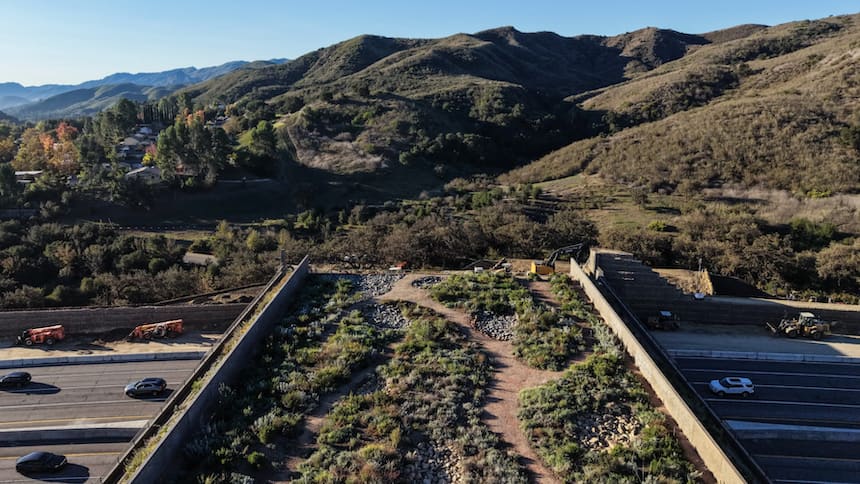
New bridge is the largest wildlife crossing in the U.S.
Being an animal living near one of the largest cities in the United States can be pretty risky.
But one lone coyote — who has likely spent a chunk of its life crossing busy roadways — may have recently let out a howl of relief.
That’s because it was the first mammal spotted crossing a new wildlife bridge built over a busy highway near Los Angeles, California.
The bridge — which is officially the biggest wildlife crossing in the world — is set to officially open on Dec. 2, but animals are already making the trek across.
Its construction was helped in part by the story of one locally famous L.A. cougar, and is meant to address the ongoing risk that the urban environment poses to animals.
The role of a special cougar
The poster cat for the campaign to build the bridge is known as P-22 — a cougar that travelled across local highways and made its home in L.A.’s Griffith Park.
In 2022, P-22 was euthanized after likely being hit by a car. Thousands attended his memorial.

This 2014 photo shows a cougar named P-22 in L.A.’s Griffith Park. The cougar became part of the campaign for the new wildlife bridge. (Image credit: U.S. National Park Service/The Associated Press)
P-22 became a symbol for animals trapped by sprawling L.A. developments and other urban threats, or at risk of being killed crossing busy roadways.
Scientists tracking mountain lions in the area found that, over decades, roadways were confining animals to the mountains along the Malibu coast, and across the middle of L.A. to Griffith Park, where P-22 had made his home.
A recent report from the University of California, Davis found that at least 780 mountain lions — totalling 18 per cent of the state’s population — are killed by traffic every year.
Scientists also found that mountain lions trapped within urban sprawl risked in-breeding, threatening extinction if something wasn’t done.
“The story of P-22 was just so compelling,” said Mari Galloway, California program director for the non-profit Wildlands Network.
“We saw the peril of what happened to that particular cat. It was demonstrative of what these mountain lions are facing in this part of the landscape.”
A similar overpass in Colorado — along with other strategic builds in the area — has resulted in a 91 per cent decrease in wildlife collisions, according to the state’s Parks and Wildlife department.

Animals, including mice, coyotes and sparrows, have already been seen crossing the new wildlife bridge ahead of its opening. (Image credit: Jae C. Hong/The Associated Press)
The world’s largest wildlife crossing
The bridge, which is in Agoura Hills, California, stretches 380 metres in two separate sections.
One section spans the U.S. 101 highway, used by some 300,000 cars daily, and the other crosses a feeder road about 56 kilometers northwest of downtown Los Angeles.
The bridge gives animals a safe crossing between urban areas and the nearby Santa Monica Mountains and beyond.
Its name — the Wallis Annenberg Wildlife Crossing — comes from the man whose foundation donated $25 million US toward construction costs, adding to thousands of donations from the public, along with government and non-profit grants.
The hope is that the crossing could save the lives of many animals, not just mountain lions.

Conservationists hope that the Wallis Annenberg Wildlife Crossing will help inspire more wildlife crossings across the country. (Image credit: Jae C. Hong/The Associated Press)
Although the bridge hasn’t yet officially opened, many insects and animals — including hummingbirds, spiders, mice, coyotes and sparrows — have already been spotted on the bridge.
“They don’t care about ribbon cuttings,” laughed Beth Pratt, one of the project’s leaders and president of the non-profit Wildlife Crossing Fund.
For Pratt — who has a tattoo of P-22 on her arm — the official opening will be when a cougar crosses the bridge for the first time.
What’s next?
Biologists say they hope to soon attach special equipment to some of the animals crossing the bridge to collect physiological data and see if they are stressed while using it.
Conservationists in the area hope that the bridge will help inspire the building of more wildlife bridges across the country.
Have more questions? Want to tell us how we’re doing? Use the “send us feedback” link below. ⬇️⬇️⬇️
With files from The Associated Press